
10 Best Budget Miter Saws for Home Projects: Our Top Picks
Selecting a budget miter saw for home projects depends on your specific goals and workspace, as no single tool fits every task. The Metabo HPT C10FCG2 is a reliable, straightforward option, while the SKIL MS6305-00 offers dual bevel flexibility. You must decide if you prioritize portability, cutting capacity, or the ability to handle multiple materials when selecting your saw.
1. Metabo HPT 10-Inch Compound Miter Saw

Best for: A first-time buyer looking for a reliable, no-nonsense tool.
This saw is built for users who need a solid, lightweight machine for standard woodworking tasks. Its 15-Amp motor is designed for consistent power, and the 24 lbs weight makes it very easy to move around your shop or garage. The 0-52° miter range provides enough flexibility for most home frames and trim projects.
The simple, single-bevel design is ideal for beginners because it reduces the complexity of adjustments. If you’re working on standard baseboards or framing, the 0-45° left bevel range and adjustable stops provide all the precision you need. However, this saw doesn’t have a sliding rail system, which limits the width of the boards you can cut in one pass. If your project requires cutting stock wider than the blade’s reach, you’ll find yourself needing to flip the board, which risks misalignment.
If you’re a professional or a hobbyist frequently tackling wide crown molding or large dimensional lumber, this fixed-rail design will prove frustrating. It isn’t for users who need to perform wide crosscuts on large stock.
Good if:
- You want a lightweight saw for easy storage.
- You prefer a simple, user-friendly control layout.
- You need a tool backed by a 5-year warranty.
Skip it if:
- You need to cut very wide boards.
- You require dual-bevel capabilities for complex trim.
2. SKIL 10″ Dual Bevel Sliding Compound Miter Saw-MS6305-00

Best for: Someone who frequently cuts crown molding or complex angles.
The dual-bevel feature allows you to tilt the blade in both directions, saving you from flipping the board over. This is a huge time-saver for detailed trim work where accuracy matters. The LED shadow line is a great addition, as it shows you exactly where the blade will land without the potential alignment issues of a laser.
The 2×12 cutting capacity is a standout feature for this size of saw, letting you handle larger lumber with ease. It’s a more complex machine than a basic chop saw, so it might take a moment to learn all the settings. It isn’t for someone who only needs to make simple, 90-degree cuts on small hobby projects.
Good if:
- You cut a lot of crown molding.
- You want a clear, reliable cutline indicator.
- You need to cut wide boards up to 12 inches.
Skip it if:
- You have a very limited workspace.
- You want the simplest setup possible.
3. Evolution Power Tools R210CMS Compound Miter Saw

Best for: A hobbyist who works with wood, metal, and plastic.
This saw is unique because it uses a specialized Japanese Tungsten-Carbide-Tipped blade designed to cut through various materials, including wood with embedded nails. It’s a compact, space-saving tool that fits well in a small workshop. The 1200W motor is optimized for this specific blade and gearbox system.
Because it’s so compact, it doesn’t offer the same wide cutting capacity as larger, sliding models. It’s a specialized tool that excels at versatility rather than pure size. If you’re cutting thin metal or plastic, the 210mm blade provides a smooth finish. However, if you’re cutting thick framing lumber, the limited capacity will force you to flip the material and make two passes. This increases the risk of an uneven seam.
It isn’t for a professional who needs to cut very large, thick timber all day long. If your projects involve heavy-duty construction, the motor’s torque may struggle under constant, high-volume demand.
Good if:
- You often repurpose old wood with hidden nails.
- You need to cut plastic or thin metal.
- You have very little room to store your tools.
Skip it if:
- You need to cut wide, thick framing lumber.
- You prefer standard blade sizes for easy replacements.
4. Genesis GMS1015LC 15-Amp 10-Inch Compound Miter Saw with Laser Guide

Best for: A DIY enthusiast who wants a laser guide for alignment.
This saw comes with a laser guide that helps you see where the cut will be before you pull the trigger. It’s a very accessible option for beginners who want to improve their accuracy. The inclusion of an electric brake is a nice safety feature that stops the blade quickly after you finish a cut.
It’s a basic compound saw without sliding rails. This limits your width capacity to what the 10-inch blade can reach in a single chop. It isn’t for someone who needs to make long, sliding cuts on wide decking boards.
Good if:
- You find lasers helpful for quick alignment.
- You want an electric brake for added safety.
- You’re starting your first set of home tools.
Skip it if:
- You need to cut very wide material.
- You prefer a sliding saw for more versatility.
5. WEN MM0713 9.5-Amp 7.25-Inch Single Bevel Compact Sliding Compound Miter

Best for: Someone with a tiny workspace who needs sliding capacity.
The dual-rail system on this saw is clever because it allows the head to slide forward and backward without needing extra space behind the tool. You can push it right up against a wall, which is perfect for small garages. Even with its 7.25-inch blade, the slide allows it to crosscut boards up to 11.5 inches wide.
The smaller blade size is the main trade-off, as it can’t cut as deep as a 10-inch or 12-inch model. It’s designed for portability and space-saving rather than heavy-duty, thick lumber. It isn’t for a user who needs to cut through 4×4 posts or very thick stock. If your material exceeds 2.5 inches in thickness, look for a larger saw.
When you prioritize footprint, remember that the 9.5-amp motor is optimized for the included 7.25-inch blade. Using a non-standard blade can compromise the 5/8-inch arbor fit or the motor’s efficiency.
Good if:
- You have a very small workshop.
- You need to cut wide boards on a budget.
- You want a lightweight, portable saw.
Skip it if:
- You need to cut very thick wood.
- You prefer a larger blade for standard replacements.
- You require a bevel cut in both directions, as this model only tilts left.
6. DOVAMAN 10-Inch Sliding Miter Saw

Best for: A user who needs to switch between wood and soft metal.
The dual-speed motor is the standout feature here. It lets you adjust the RPM for different materials like PVC or soft metal. Use 5000RPM for standard wood cuts and drop to 3200RPM for cleaner results on softer metals. The saw comes with two 40-tooth and one 48-tooth TCT blades, making it a complete package for someone who does a bit of everything.
The 13-inch sliding rail provides plenty of reach for wider projects. It accommodates materials up to 4 x 13 inches, which is useful for larger boards. The built-in laser guide helps ensure accuracy on complex cuts.
This saw is built for those who tackle a wide variety of tasks. It might be overkill if you only build simple wooden picture frames. The dual-speed settings require more attention during setup. If you don’t adjust the speed to match the material, you risk damaging the blade or the workpiece. It isn’t for a beginner who wants a simple “plug and play” tool.
Good if:
- You work with a mix of wood, plastic, and metal.
- You need the reach of a 13-inch sliding rail.
- You want multiple TCT blades included in the box.
Skip it if:
- You only ever cut wood.
- You want a basic tool without speed settings.
- You prefer to avoid the maintenance of a 15-amp motor.
7. DOVAMAN 12-Inch Dual-Bevel Sliding Compound Miter Saw
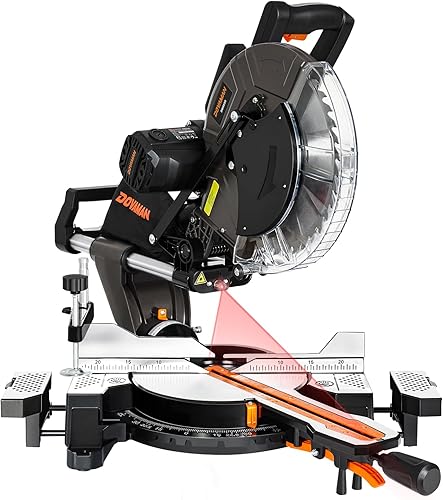
Best for: A serious DIYer who needs maximum cutting capacity.
With a 12-inch blade and a sliding rail, this saw has the largest cutting capacity of the group. It handles boards up to 4.2 by 13 inches, making it a workhorse for framing or large furniture projects. The dual-bevel design allows you to tilt the head both ways for complex compound angles.
Because this sliding saw is built for maximum capacity, it is quite large and heavy. You’ll need a sturdy, dedicated workbench to support its footprint. It isn’t for someone who needs to move their saw to different job sites every week.
If you’re setting this up for the first time, verify the miter angle before your first cut. Factory settings can shift during shipping. Use the nine common angle presets—including 22.5° and 45°—to lock in your settings quickly. If your cuts aren’t square, recalibrate the base immediately to avoid wasting lumber.
Good if:
- You need to cut large, wide, or thick boards.
- You do frequent compound angle cuts.
- You want a high-capacity tool for big projects.
Skip it if:
- You have very little storage space.
- You need a highly portable tool.
8. Prostormer 12-Inch 15A 5000 RPM Sliding Compound Miter Saw
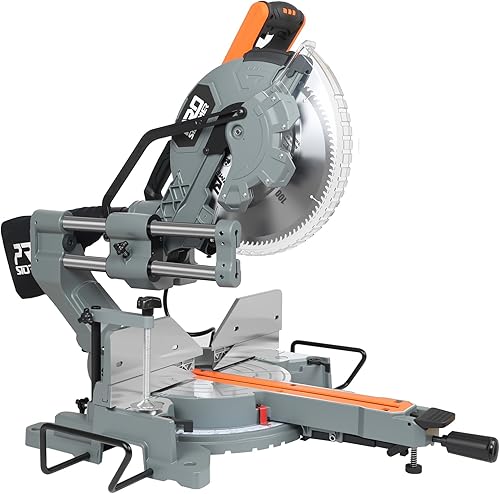
Best for: Someone who wants a powerful, professional-style sliding saw.
This 12-inch saw is designed for stability and power. The 15-Amp motor and large blade help it glide through wood and composite materials at 5,000 RPM without bogging down. It includes a cutting depth gauge, which is excellent for making grooves or “dado” cuts for joinery.
It’s a heavier machine, weighing 42 lbs, which reflects its solid build. While it’s portable, it’s better suited for a permanent station in your shop where it can be bolted down using the four base mounting holes. If you find your cuts drifting, secure the base to a workbench immediately to regain accuracy. It isn’t for someone who needs a light, compact tool for quick, occasional tasks.
The axial sliding system allows the head to glide forward and backward effortlessly. Unlock the slide lock knob to extend cutting capacity on wider boards or position the saw flush against a wall to save space.
Good if:
- You need to make deep, precise cuts.
- You want the flexibility of a sliding rail system.
- You like having a depth gauge for joinery.
Skip it if:
- You need a lightweight, easily portable saw.
- You have a very limited budget for space.
9. Ryobi 10 in. Compound Miter Saw with10 IN. COMPOUND MITER

Best for: Someone who wants a clean, easy-to-use tool for home projects.
The LED cutline indicator is the highlight here, as it effectively shows where the blade will hit without needing to worry about laser alignment. It’s a straightforward 10-inch compound saw that’s very easy to operate for standard home repairs. The 14-Amp motor provides plenty of power for most softwoods and trim, spinning the 24-tooth carbide-tipped blade at 5,500 RPM.
It doesn’t have a sliding rail, so you’re limited to the width of the standard blade’s reach. If you’re cutting material wider than the blade’s depth, you’ll need to flip the board to finish the cut, which often leads to uneven edges. It’s a great tool for beginners, but it lacks the advanced capacity of sliding models. It isn’t for users who need to cut wide boards, like flooring planks, in a single pass.
Connect the 1-1/4 inch dust port to a vacuum system to keep your workspace clear. If you’re working in a smaller area without a vacuum, the included dust bag provides a portable alternative. Always use the provided work clamp to secure your material before starting the motor to ensure safety and precision.
Good if:
- You want a simple, reliable saw for home projects.
- You prefer an LED light over a laser.
- You’re already familiar with the brand’s ecosystem.
Skip it if:
- You need to cut very wide boards.
- You want a sliding saw for more capacity.
10. SEESII 8-1/4″ Compound Miter Saw with Laser 4900RPM Single Bevel

Best for: A woodworker who prioritizes a lightweight, precise build.
This saw is very light, making it excellent for someone who might need to store it on a shelf and pull it down only when needed. The laser guide is quite helpful for keeping your cuts straight, and the tilt protection is a smart safety feature to prevent the saw from tipping over during angled cuts.
The 8-1/4-inch blade is smaller than the most common standard saw size. Use this tool for trim, cabinetry, or decorative work where precision matters more than raw capacity. If you’re cutting crown molding or picture frames, the integrated scaled fence helps you maintain accuracy across repeated cuts.
The machine isn’t for someone who needs to frame a deck or build large outdoor structures. While the 4900 RPM motor handles hardwoods and lumber, the smaller blade limits your depth of cut. You’re restricted to a maximum capacity of 115x60mm at a 0° miter and 90° bevel. If your project requires cutting through thick stock beyond these dimensions, this compact tool will force you to flip the material and risk an uneven finish.
Good if:
- You want a very lightweight, easy-to-carry tool.
- You do a lot of trim and cabinetry work.
- You appreciate safety features like tilt protection.
Skip it if:
- You need to cut thick, heavy lumber.
- You want a standard blade size that is widely available.
Where These Overlap
Most of these saws share a 15-Amp motor, which is the industry standard for home-grade tools. This power level is sufficient for almost any DIY task, from cutting trim to framing small projects. The biggest difference is whether the saw is a “sliding” model or a “compound” model. A sliding saw has rails that let the blade move forward and backward, drastically increasing how wide of a board you can cut. Compound saws are simpler and often more compact, which makes them better for someone who only needs to make quick, narrow cuts.
If you’re choosing between models like the Metabo HPT C10FCG2 and the Ryobi Compound, the choice often comes down to personal preference for the brand or the specific light indicator type. These two are very close in capability. However, once you compare them to a sliding model like the Prostormer, the difference in capacity becomes obvious. If your projects involve wide boards, you should ignore the non-sliding options entirely. If you only cut baseboards or picture frames, the sliding rails might just be extra weight you don’t need.
Still Not Sure?
How much space do I have?
If you have a large shop with a dedicated workbench, a high-capacity sliding saw like the Prostormer is a fantastic choice. These models are heavy and take up a lot of room, but they offer the most capacity. If you have a small garage or a shared workspace, look for a compact sliding saw like the WEN MM0713. It gives you the sliding reach you need without the massive footprint of the largest professional models. Always measure your storage area before you decide.
Do I need to cut wide boards?
This is the most important question for any buyer. If you plan to cut wide boards for flooring, decking, or large signs, you absolutely need a sliding saw. A standard compound saw, like the Metabo HPT C10FCG2, will leave you frustrated if the board is too wide for the blade. If you only plan to cut small trim, baseboards, or thin framing, a standard compound saw is easier to set up and maintain. Think about your next three projects to see if you’ll need that extra sliding reach.
Should I worry about the blade size?
This blade is the most common size, meaning you can find replacements in any local hardware store. The largest saws provide more depth, which is great for thick timber. The 7.25-inch or 8-1/4-inch blades are excellent for portability and trim, but they can’t handle thick, heavy wood. If you choose a saw with a non-standard blade size, just make sure you’re comfortable with the availability of replacements. The SEESII 8-1/4-Inch Compound is a great example of a compact, precise choice.
As an Amazon Associate, we earn from qualifying purchases. This post contains affiliate links – if you buy through them, we may earn a commission at no extra cost to you.
Choosing the right miter saw is about matching the tool’s capacity to your most common projects. If you need wide cutting reach for flooring or decking, a sliding model like the Prostormer is the right path. If you prefer a simpler, lighter tool for trim and small wood crafts, the Metabo HPT C10FCG2 is a reliable choice for your workshop. Once you identify your primary cutting needs, check your available storage space to ensure the saw fits your lifestyle before you make your final selection.
Related guides
- 10 Best Circular Saws: Our Expert Picks for Every Project
- 10 Best Cordless Circular Saw Picks for Every Project Type
- 10 Best Corded Hammer Drills for Home Projects and Masonry
Frequently Asked Questions
Do I need a dual-bevel or a single-bevel saw?
A single-bevel saw tilts the blade in one direction, while a dual-bevel saw tilts in both. If you frequently cut crown molding or complex trim, a dual-bevel saw like the SKIL MS6305-00 is much faster because you don’t have to flip the board over to make matching cuts. If you only make simple, 90-degree cuts or basic miter angles, a single-bevel saw is perfectly fine and often simpler to use.
How do I maintain my miter saw?
Keep your saw clean to ensure optimal performance. Use a shop vacuum or leaf blower to clear sawdust from the rails and motor housing after every use. Note that dull blades put extra strain on the motor and cause inaccurate cuts.
What is the advantage of a laser guide?
A laser guide helps you visualize your cut line before pulling the trigger. Models like the Genesis GMS1015LC use this to assist beginners with quick alignment. Keep in mind that lasers require recalibration if they are bumped or jarred.
Can I change the blade on my miter saw?
Yes, every saw listed allows you to change the blade for different tasks or when the blade dulls. Use the arbor lock button and the included wrench to loosen the bolt. Always ensure your replacement blade matches the diameter and arbor size specified in your manual.
Conclusion
Once you’ve picked the perfect saw, don’t forget to invest in a high-quality blade to ensure your cuts stay clean and precise. It’s also a good idea to set up a dedicated workspace where you can practice safely. You’ll be tackling those home improvements with confidence before you even know it.