Best Plunge Routers for Router Table Use: What to Check Before Buying
As an Amazon Associate, we earn from qualifying purchases. This post contains affiliate links – if you buy through them, we may earn a commission at no extra cost to you.
Selecting a plunge router for a table requires balancing your specific project needs with the equipment already in your shop. There is no single ideal model, as the right choice depends on whether you prioritize motor power for heavy stock removal or convenient height adjustments for frequent changes. Some woodworkers prefer the Makita RP2301FC for its raw torque, while others favor the Triton TRA001 for its ease of adjustment from above the table. Evaluating these features helps you decide which tool best suits your workflow.
1. Bosch 1617EVSPK 2.25 HP Combination Plunge- and Fixed-Base Router

Best for: A woodworker who needs one reliable tool for both handheld and table use.
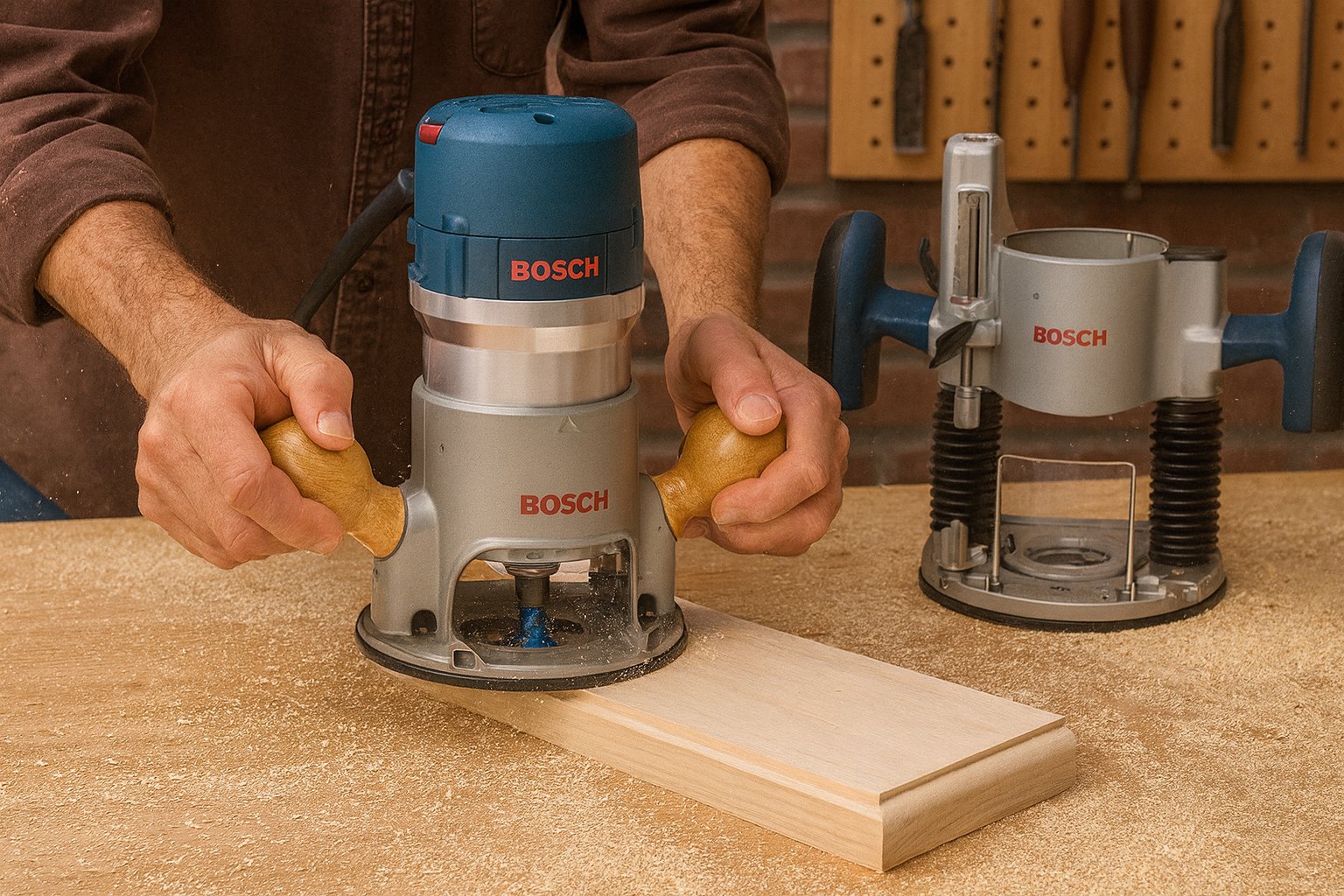
This router is a versatile choice because it comes with both a fixed base and a plunge base. The fixed base is preferred for table mounting, as it allows for simple height adjustments. The plunge base provides better control for freehand work. The 12-amp motor handles standard tasks, while the constant response circuitry helps maintain speed when the bit meets resistance.
The three-hole base pattern allows for quick mounting to most standard router tables without needing custom plates. If you’re mounting it to a table, use the fixed base to ensure stability. For freehand projects requiring depth control, switch to the plunge base.
This model isn’t designed for the heaviest professional-grade production work that requires the largest bits. If you’re a beginner or a hobbyist looking for a solid all-rounder, this kit covers almost every base. Use the adjustable speed dial, which ranges from 8,000 to 25,000 RPM, to match the bit size to your material. Larger bits require slower speeds to prevent burning the wood.
Good if:
- You want one router to use both in and out of a table.
- You need a reliable, standard-sized motor for general cabinetry.
- You prefer a simple, proven design with a dust-sealed switch.
Skip it if:
- You only plan to use the router inside a table permanently.
- You require the highest horsepower available for heavy, deep cuts.
- You’re performing industrial production work that demands continuous, high-torque operation.
2. DEWALT Router Fixed/Plunge Base Kit

Best for: Users who need a heavy-duty motor that handles tough hardwoods smoothly.
This model features a 2-1/4 horsepower motor and a micro-fine depth adjustment ring that moves in 1/64-inch increments. This precision is vital when you’re trying to dial in a perfect fit for joinery or profile cuts. The tool-free motor cam lock makes it very quick to move the motor between the plunge base and a table-mounted fixed base.
If you struggle with startup kick, the soft-start feature is your primary defense. It reduces torque to keep the tool steady in your hands the moment you pull the trigger. For consistent results, rely on the full feedback control. It maintains a steady speed between 8,000 and 24,000 rpm even when the 12-amp motor encounters heavy resistance in dense grain.
The through-the-column dust collection is a smart touch for keeping your workspace clean, capturing 95% of debris while keeping the bit visible. This is a robust workhorse, but the system relies on the user being comfortable with the specific motor pack latch design. It’s a great choice for someone who wants to upgrade their shop’s primary routing capabilities.
Good if:
- You frequently work with dense, difficult hardwoods.
- You need precise, measurable depth adjustments for joinery.
- You want a motor that’s easy to remove from the base.
Skip it if:
- You prefer a simpler, single-base setup without extra components.
- You don’t have an existing dust collection system to hook up.
3. Triton TRA001 3-1/4 HP Dual Mode Precision Plunge Router

The Triton TRA001 is a favorite for table users because of its micro-winder feature. This allows you to adjust the bit height continuously through the full plunge range, which is much easier than reaching under the table to crank a standard base.
If you’re mounting this in a table, use the micro-winder for all fine depth adjustments. This eliminates the need to reach underneath, saving you from awkward postures and imprecise manual settings.
The single-button switch from plunge to rack-and-pinion mode makes this a unique tool for different setups. If you find yourself switching between handheld and table-mounted tasks, ensure the rack and pinion is fully engaged before starting the motor.
The automatic spindle lock is another highlight, letting you change bits with a single wrench through the base. This saves time and frustration when the router is fixed. Always verify the spindle is locked before applying torque to the nut to prevent internal gear damage.
Because this is a 3-1/4 HP tool, it’s heavy. It’s best suited for a permanent station rather than being moved around the shop for handheld work. If you primarily perform freehand routing, the weight will cause fatigue quickly.
Use the variable speed dial to match the cutter size to the material. If the motor struggles, you’re likely moving too fast or using a dull bit.
Skip this model if you need a lightweight router for handheld freehand routing. It’s built for power and table stability, not agility.
4. Makita RP2301FC 3-1/4 HP* Plunge Router

Best for: High-volume work that requires the most powerful motor available.
With a 15-amp motor, this is a serious tool for demanding projects. The electronic speed control maintains a steady RPM between 9,000 and 22,000 under heavy load. This ensures your cuts stay smooth even when you’re pushing through wide, dense boards. It also includes an electric brake, which stops the bit quickly after you turn the power off. This feature adds a layer of safety and convenience during high-speed production runs.
This router is built for power, and it feels substantial in the hand. Because of its weight and size, it’s most at home in a sturdy, well-supported router table. It lacks some of the compact features found in smaller models, but it makes up for it with sheer force. If you’re performing light edge work or handheld joinery, the tool’s mass may lead to fatigue. Save this model for heavy-duty, stationary routing where the tool carries the weight.
Good if:
- You regularly cut large profiles or deep dados.
- You value the safety and speed of an electric brake.
- You need consistent power for long, continuous routing sessions.
Skip it if:
- You’re looking for a compact router for small-scale projects.
- You don’t have a heavy-duty table to support a large tool.
- You prioritize portability over raw torque.
5. SKIL 14 Amp Plunge and Fixed Base Router Combo

This kit is ideal for a first-time buyer who wants a clear guide for speed settings. The standout feature is the LCD display, which recommends speeds based on the specific bit type and material you select. For a newcomer, this takes the guesswork out of setup and helps prevent burning your wood or dulling your bits.
If you’re cutting through dense hardwoods, the electronic feedback system ensures the 14 Amp, 2.5 HP motor maintains a steady RPM. Without this, the motor might bog down under load, leading to uneven cuts or stalling. The soft start feature further improves control, preventing the tool from jerking when you first trigger the power.
Safety is prioritized through the live tool indicator, which lights up the moment the router is connected to a power source. Use this as a final check before changing bits to ensure the unit is truly dead. The kit includes both fixed and plunge bases, allowing you to transition between edge work and deep mortising without buying separate tools.
If you’re an experienced user who already knows your preferred speeds by ear or feel, the digital interface may feel unnecessary. Similarly, if you require industrial-grade, long-term precision for fine furniture, you might find the tolerances of this combo kit limiting.
Choose this unit if you want a complete, ready-to-use package that minimizes the learning curve. It provides a reliable balance of power and guidance for those just starting their woodworking journey.
6. DEWALT 20V MAX XR 2-1/4 Peak HP Plunge Router

Best for: Someone who needs to work in areas without easy access to power.
This is an impressive cordless option for those who find power cords to be a nuisance. It’s powerful enough to handle standard roundovers and grooves, making it great for light-to-medium shop tasks. When using the DCBP520 battery, you can complete up to 256 linear feet of 5/8-inch roundovers in pine on a single charge.
The anti-rotation system is a vital safety feature that senses rotational motion and shuts the tool down if the movement becomes excessive. You’ll know the system has engaged when the red LED indicator illuminates.
Because it’s cordless, you’re limited by battery life, though it’s efficient for its class. The tool-free depth adjustment and the 3-position turret stop make it surprisingly easy to set up for repeatable cuts. Use the variable speed dial to match the tool to your material, ranging from 11,000 to 23,000 RPMs.
It’s best used for mobile jobs or situations where a cord would simply get in the way of your work. Always pair it with the DWV015 dust extractor to capture up to 97% of debris when cutting grooves in particleboard.
Good if:
- You work in a shop where cords are a constant safety hazard.
- You need a portable router for finishing touches on large projects.
- You want the latest safety features like the anti-rotation system.
Skip it if:
- You have long, heavy-duty routing tasks that would kill a battery.
- You don’t want to invest in a specific battery platform.
7. Festool 578951 OF 1400 EQ-F-Plus Plunge Router

Best for: Professionals who demand extreme precision and ergonomic comfort.
Festool is known for its high-end build quality, and the OF 1400 is no exception. The dual-sided guide column clamping provides excellent stability, which is essential for accurate routing. The micro-fine depth adjustment is incredibly precise, allowing for 0.1 mm increments. Use this feature for delicate inlay work or perfect-fit joints where a hair’s breadth makes the difference between a tight seam and a gap.
The integrated LED dust hood is a standout feature that keeps your cut line visible while capturing nearly all the debris. When paired with the chip catcher, you can achieve up to 99% dust extraction. If you find your cut line obscured by sawdust, the LED illumination is the solution.
While this is a premium tool, it’s designed to integrate into a wider system of templates and accessories. It’s an investment for the serious woodworker who plans to use the tool daily for many years. If you’re switching bits frequently, the ratcheting spindle lock saves significant time compared to traditional dual-wrench methods.
Good if:
- You need the highest level of precision for fine cabinetry.
- You want excellent dust extraction for a cleaner shop.
- You plan to use it as part of a larger, integrated system.
Skip it if:
- You’re on a strict budget and only do occasional routing.
- Skip it if you don’t need the advanced features.
8. BOSCH GOF13-25 1-3/4 HP Mid-Size Plunge Router

Best for: Mid-sized projects that don’t require a massive, heavy motor.
This router sits in the sweet spot for users who find standard routers too heavy but small trim routers too weak. The 1-3/4 HP motor handles most cabinetry tasks with ease. Its ergonomic handles and slim grip design reduce fatigue during longer sessions.
The included parallel guide and roller guide provide necessary support for consistent edge profiling. If you’re performing multiple passes, use the integrated depth stop and its eight-stop increments to ensure consistent results.
The handle-mounted speed dial allows you to adjust the motor from 11,000 to 28,000 RPM without taking your hands off the tool. Match the higher speeds to smaller bits for clean finishes, or drop to lower settings when using larger bits to prevent burning the wood.
It’s a straightforward, reliable machine that covers the basics without unnecessary complexity. If you want a comfortable, mid-range router that’s easy to manage, this is a strong contender. Bosch covers this tool with a one-year limited warranty.
Good if:
- You want a comfortable, lightweight tool for extended use.
- You need a reliable router for general woodworking and cabinetry.
- You prefer having essential guides like the centering pin and dust hood included in the box.
Skip it if:
- You need to perform heavy-duty, large-bit routing that requires more than 1-3/4 HP.
- You prefer a router with digital displays or advanced electronic feedback systems.
Where These Overlap
Many of these routers share similar 12-amp to 15-amp motors and variable speed functionality, but the nuances define their utility. The Bosch 1617EVSPK and DEWALT DW618PK occupy a similar market space, providing reliable power for general shop use. If choosing between these, prioritize the interface: the Bosch features rounded hardwood handles for grip, while the DEWALT uses a tool-free steel motor cam lock for faster base changes.
The Makita RP2301FC and Triton TRA001 lean toward the heavier end of the spectrum, yet they serve distinct workflows. The Triton is built for above-the-table convenience, featuring a micro-winder for continuous depth adjustment and single-wrench bit changes. Conversely, the Makita focuses on high-torque output and includes an electric brake for immediate productivity.
The rest of the field represents specialized needs. The SKIL RT1322-00 simplifies the learning curve with an LCD display that suggests speeds based on the bit and material. If your priority is extreme accuracy, the Festool OF 1400 offers micro-fine adjustments down to 1/256-inch. If you encounter excessive rotational motion, the DEWALT DCW620B includes an anti-rotation system that automatically shuts down the tool to prevent injury.
Still Not Sure?
How often will I really use it?
If you only plan to route a few edges once or twice a year, you don’t need the power of a professional-grade motor. A mid-sized tool like the Bosch GOF13-25 will likely handle everything you throw at it without the added weight of an industrial unit. However, if you’re building a full set of kitchen cabinets, you should look at the Makita RP2301FC for its sustained power.
What do I already own that this has to work with?
Think about your existing router table. Some routers, like the Triton TRA001, are designed specifically to make table-mounting easier with above-the-table adjustments. If your table is already set up and you don’t want to drill new holes, check the base plate compatibility. If you already have a collection of Festool accessories, the Festool OF 1400 will offer the best integration for your current workflow.
What am I most likely to regret choosing?
The most common regret is buying a router that’s too heavy for the tasks you actually perform, or one that’s too weak to handle your intended wood species. If you buy a small cordless model like the DEWALT DCW620B expecting to cut large grooves in oak, you’ll be disappointed. Always match your tool’s horsepower to the material density, as recommended by ANSI safety standards for power tool use.
Choosing the right plunge router for a table balances power with adjustment convenience. For a versatile tool, the Bosch 1617EVSPK is a reliable choice, while the Triton TRA001 excels at easy table-mounted height adjustments. Match your specific project needs to these features and begin your next build today.