Track Saw Guide Rail Compatibility: Which Brands Work Together?
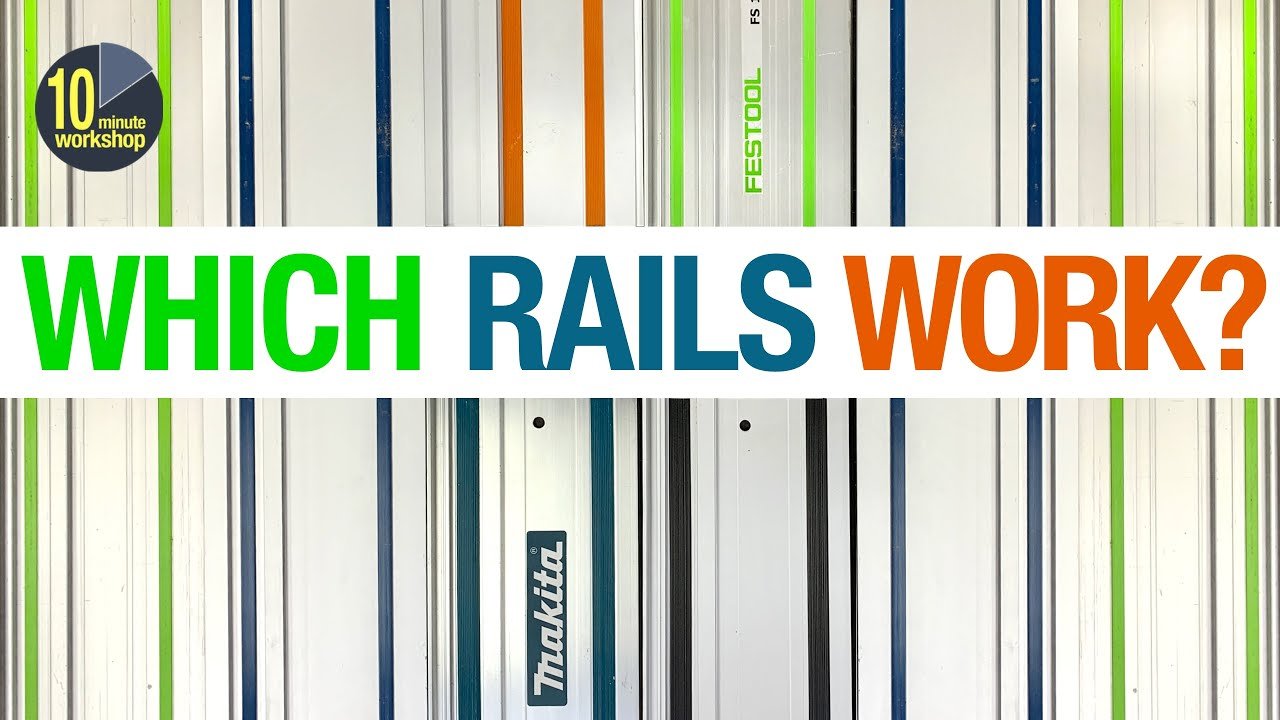
Mixing track saws and guide rails from different manufacturers is often difficult, yet necessary when expanding a workstation. Although companies market their systems as proprietary, many brands share similar rail geometries. Understanding which equipment is interchangeable allows you to combine tools from various makers while maintaining the precision and safety required for your projects.
Key Takeaways
- Festool and Makita rails share a nearly identical profile, allowing them to be used interchangeably with most saws.
- DeWalt rails feature a distinct T-shape profile that generally doesn’t accept Festool or Makita base plates without modification.
- Using an incompatible rail can lead to blade deflection, binding, or dangerous kickback during operation.
- Third-party connectors are often necessary when joining rails from different manufacturers to ensure perfect alignment.
- Always check the base plate clearance of your specific saw model before attempting to use a rail from a different brand.
Rails That Share Geometry
The most common cross-compatibility exists between Festool and Makita systems. These two brands utilize a rail design that allows a Festool TS series saw to glide smoothly on a Makita guide rail and vice-versa. This is a massive benefit for woodworkers who might own tools from both companies.
However, you must always ensure that the anti-chip strip is properly calibrated for the specific saw you’re using, as the blade position relative to the edge of the rail can vary by a few millimeters between models.
| Brand A | Brand B | Compatibility Status |
|---|---|---|
| Festool | Makita | High (Direct Fit) |
| Festool | Triton | Moderate (Requires Adjustment) |
| Makita | Triton | Moderate (Requires Adjustment) |
| DeWalt | Festool | Low (Incompatible) |
| Bosch | Mafell | High (Direct Fit) |
The DeWalt Rail Exception
DeWalt tracks are built with a unique geometry that differs significantly from the European-style rails used by Festool and Makita. Because the DeWalt rail is wider and features a different channel depth, attempting to mount a non-DeWalt saw on these tracks usually results in significant side-to-side slop or an inability for the saw to engage with the guide edge entirely. If you own DeWalt gear, it’s almost always best to stick to the DeWalt ecosystem to maintain optimal cutting accuracy.
Can You Use Universal Adapters?
If you’re determined to bridge the gap between different brands, you might consider using a universal guide rail adapter. These accessories mount to the base of your saw and provide a sliding mechanism that can be adjusted to fit various track widths. While these can work, they often introduce an extra point of failure or mechanical play. For professional cabinet making or fine furniture, the structural integrity of a dedicated, brand-matched rail system is superior to any adapter-based solution.
Which Brands Are Actually Identical?
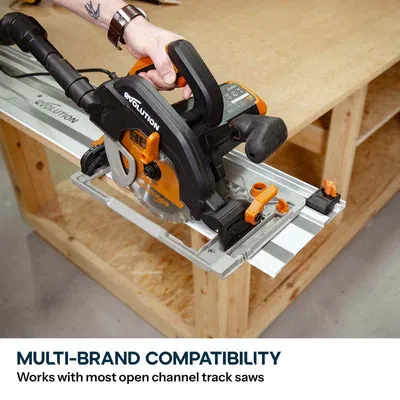
In the professional woodworking market, certain companies share manufacturing standards. For instance, Bosch and Mafell have a long-standing partnership regarding their guide rail systems. If you purchase a Bosch professional track saw, you’ll find that it fits perfectly onto a Mafell rail. This is because these two companies utilize the same extrusion profile. This cross-compatibility is standard practice in many high-end European tool lines, where the focus is on creating a unified workshop environment for contractors.
How to Check Your Rail Fit
Before you commit to using a rail from a different brand, perform a dry run without the power connected. Place your saw on the rail and check for lateral movement. There should be zero play between the saw’s guide groove and the rail’s raised rib.
If you notice any wiggle, you must adjust the guide cams on your saw base. If the saw can’t be adjusted to eliminate the play, the rail isn’t compatible. Ignoring this will lead to inaccurate bevel cuts and potential damage to your saw blade.
Are There Safety Risks Involved?
Warning: Using a saw on a rail that doesn’t match its base configuration can lead to the saw jumping off the track. When a saw isn’t fully captured by the rail, the risk of binding increases significantly. Binding is the primary cause of kickback, which can result in serious injury. Always verify that the saw base is fully engaged with the rail before pulling the trigger.
Troubleshooting Common Rail Issues
If you find that your saw is binding on a track that should be compatible, check for debris in the guide channel. Even a small amount of sawdust or resin buildup can interfere with the smooth travel of the saw base.
Use a dry lubricant to keep the rail surfaces slick, but avoid oil-based products, as these will attract more dust. Additionally, ensure that your rail connectors are tightened evenly; if the joint isn’t perfectly flush, the saw will snag every time it passes over the connection point, ruining your finish quality.
How Different Brands Work With Track Saw Guide Rails
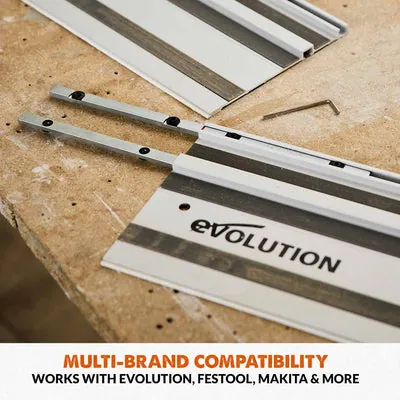
Connecting rails from different manufacturers is rarely a “plug and play” experience. Even if the profiles match, the connector channels might be positioned at slightly different depths or widths. You’ll likely need to source universal rail connectors that are designed to bridge these gaps.
These connectors typically feature set screws that allow you to align the rails perfectly. It’s highly recommended to use a long straightedge to verify the alignment of the joined rails, as even a 0.5-millimeter misalignment can result in a visible seam on your wood.
Why Do Brands Use Proprietary Tracks?
Many manufacturers design proprietary tracks to lock users into their specific ecosystem. By creating a unique rail profile, they ensure that you continue to purchase their accessories, such as clamps, splinter guards, and miter gauges.
While this can be frustrating for the consumer, it also allows the manufacturer to guarantee a level of performance that’s impossible to maintain when third-party variables are introduced. When you purchase a complete system, you’re paying for the integrated engineering that ensures every component works in harmony.
Related guides
- Track Saw vs. Table Saw: Which One Do You Need?
- Corded vs. Cordless Track Saws: Which One Is Worth Buying
- Best Track Saws: What to Look for Before You Buy
Frequently Asked Questions
Can I use a Festool saw on a DeWalt track?
No, you can’t use a Festool saw on a DeWalt track. The rail profiles are fundamentally different in width and geometry. Attempting to force the saw onto the track will lead to extreme instability, making it impossible to achieve a straight, safe cut. You would need to replace the saw’s base or use a specialized, non-standard adapter, which is rarely recommended for safety reasons.
Will a Makita saw fit on a Festool rail?
Yes, a Makita track saw will generally fit on a Festool guide rail. The two companies share a very similar rail geometry, which is a popular feature among professionals who own both brands. However, you should always double-check the fit of the guide cams on your saw base to ensure there’s no lateral play, as even minor variations can affect your precision.
Are all guide rail clamps universal?
No, guide rail clamps aren’t universal. While some clamps may physically fit into the channel of multiple rail brands, the tensioning mechanism and the shape of the clamp head are often designed specifically for the T-slot of a particular brand. Using the wrong clamp can result in the rail shifting during a cut, which can damage your material and potentially the saw blade.
How do I know if my track is damaged?
Inspect your track for dents, deep scratches, or bends in the aluminum extrusion. If the guide rib is deformed, your saw won’t slide smoothly, leading to binding. Additionally, check if the track sits perfectly flat on your workbench. A warped track will produce wavy cuts that can’t be corrected by adjusting the saw. If the extrusion is bent, the track must be replaced.
Is there a benefit to buying a rail system kit?
Yes, buying a complete kit ensures that all components, including the rail, connectors, and saw, are calibrated to work together perfectly. This eliminates the guesswork of compatibility and ensures that your splinter guard and anti-tilt features function as intended. Kits also typically include storage solutions and necessary mounting hardware, providing a more reliable and cohesive experience for the user compared to mixing and matching individual parts.
Conclusion
To get the most out of your setup, start by identifying the exact model of your saw and checking the manufacturer’s official documentation for compatible rail series. If you’re still unsure, perform a test cut on a scrap piece of wood to verify the fit and accuracy. Once you confirm compatibility, invest in high-quality rail connectors to ensure your tracks stay perfectly aligned for every long-format cut you make.