10 Best Miter Saws for DIYers, Woodworkers, and Contractors
This page contains Amazon affiliate links. As an Amazon Associate we may be paid a commission if you buy something through them, which costs you nothing.
Choosing the right tool depends on your workspace, the materials you cut, and how often you move your equipment. Some buyers prioritize raw cutting power for thick lumber, while others need a compact design for small shops or easy transport to jobsites. The Best Miter Saws for DIYers, Woodworkers, and Contractors landscape is split between stationary, high-capacity models and portable, sliding units. If you need maximum capacity for wide boards, the DEWALT DWS780 is a common choice, while those focused on a small footprint often look to the Makita LS1019L.
1. DEWALT 12-inch Double Bevel Miter Saw (DWS780)

Best for: Professionals needing high-capacity precision for daily, heavy-duty construction tasks.
This saw is built for power and constant use, featuring a 15-amp, 1100-watt motor that reaches 3,800 RPM. It’s engineered specifically for demanding applications where durability is the primary requirement. If you’re handling repetitive, high-volume cuts, this motor design provides the sustained torque necessary to prevent stalling under load.
The integrated cutline system avoids the need for manual alignment. By utilizing XPS LED shadow line technology, the saw projects a precise shadow directly onto your material. This ensures that you see exactly where the blade will land before you pull the trigger. If you find yourself constantly recalibrating your tools, this adjustment-free system will save you significant setup time.
This model isn’t for the occasional hobbyist who only makes simple, infrequent cuts. Its dimensions of 35cm x 45cm x 25cm are geared toward permanent workstations or frequent jobsite transport. If you have a very limited workspace, the footprint may prove too bulky for your needs. However, the dust collection system captures over 75% of debris, which keeps a busy workspace significantly cleaner during long projects.
Good if:
- You require consistent, adjustment-free cutline indication.
- You’re tackling heavy-duty, repetitive woodworking projects.
- You prefer a tool with a proven, robust motor design.
Skip it if:
- You have a very limited workspace and need a small footprint.
- You only perform light, occasional DIY tasks.
2. Makita LS1019L 10″ Dual-Bevel Sliding Compound Miter Saw with Laser

Best for: Woodworkers who need the capacity of a 12-inch saw in a smaller, lighter frame.
The linear ball bearing system is engineered to deliver precise, “dead-on” cuts for fine finish work. Its unique 2-steel rail design allows you to operate the saw flush against a wall, saving valuable space in a crowded shop. This makes it a smart choice for those who don’t want to sacrifice cutting capacity for a smaller tool footprint.
The saw is optimized for crown molding, offering a 6-5/8 inch nested capacity. This specific engineering allows it to match the performance of larger 12-inch saws. If your work involves consistent crown molding installation, this tool provides that necessary vertical reach without the bulk of a larger machine.
At 57.9 pounds, this model prioritizes portability. It’s the most compact design in its class, making it ideal for frequent jobsite movement.
However, the saw isn’t intended for those who need to cut extremely thick, wide timbers that exceed its specific vertical and horizontal limits. If your primary task involves heavy framing lumber rather than finish work, look for a saw with a larger blade diameter.
Good if:
- You need to work in tight spaces against a wall.
- You prioritize high precision for finish carpentry.
- You want a lighter, more portable 10-inch sliding saw.
Skip it if:
- You’re cutting materials wider than its specified slide range.
- You don’t need crown molding-specific capabilities.
3. SKIL 10″ Dual Bevel Sliding Compound Miter Saw-MS6305-00

Best for DIYers who want high-speed cutting and clear visibility of the cut line.
With a 15-amp motor hitting 4,800 RPM, this saw is built for quick results. The LED shadow line provides high precision, as it is not subject to the calibration requirements of laser guides. It cuts 2×12 lumber at 90 degrees and 2×8 lumber at 45 degrees, offering enough versatility for most home framing projects.
The dual bevel feature includes four positive stops at 48 degrees and 45 degrees left, 0 degrees, and 45 degrees right, making angle changes fast. If you’re framing a deck, use the 11 positive stops to quickly lock in common angles up to 50 degrees left and right. This saves time compared to manually adjusting and measuring every single cut.
This tool isn’t built for industrial-grade, round-the-clock commercial production, but it suits a serious home shop perfectly. If you find your cuts drifting, check that the material is flush against the fence before engaging the blade.
Good if:
- You want a bright LED shadow line for accuracy.
- You frequently cut common lumber sizes like 2×12.
- You need quick, positive stops for common angles.
Skip it if:
- You need a tool for heavy, industrial-grade daily use.
- You require specialized bevel ranges beyond standard settings.
4. Metabo HPT 12-Inch Dual Bevel Sliding Miter Saw

Best for: Professionals who want a wide bevel range and a long-term warranty.
This 12-inch saw provides a bevel range of 45 degrees in both directions, allowing for complex compound cuts. The one-touch bevel and miter lock are meant to save time during adjustments. It includes a 5-year warranty, which provides long-term coverage for those investing in professional-grade gear.
The saw is designed for reliability, but it’s a larger unit. It isn’t the best fit for someone with a small, mobile setup who needs to move the tool constantly. If your workspace is cramped, the sliding mechanism requires significant clearance behind the unit to operate fully.
The Xact Cut Shadow Line is the tool’s most practical feature for daily accuracy. Use this LED-projected line rather than relying on the blade teeth to align your stock. If the shadow appears fuzzy, check the lens for dust; a clean lens is the difference between a perfect fit and a ruined board.
Good if:
- You want the security of a 5-year manufacturer warranty.
- You need flexible dual bevel capabilities for complex projects.
- You prefer quick, one-touch locking mechanisms.
Skip it if:
- You’re short on storage space.
- You don’t require the largest blade capacity available.
5. Metabo HPT 10-Inch Compound Miter Saw

Best for: Beginners or those looking for a simple, lightweight, and portable solution.
Weighing only 24 lbs, this saw is easy to move and store, making it ideal for small garages or weekend projects. Despite its compact nature, the 15-amp motor provides enough power for most standard woodworking tasks. The vice clamping system is a helpful addition for securing materials safely during operation.
It’s a single-bevel saw, which means it’s less versatile than dual-bevel models for complex trim work. This tool isn’t for a professional cabinet maker who needs to perform intricate compound cuts without flipping the workpiece. If you find yourself constantly rotating boards to finish a single frame, you have outgrown this model.
The 0-52° miter range and 0-45° left bevel range cover most common angles. Use the adjustable bevel stops to lock in your settings quickly. If your project requires frequent changes between left and right bevels, this single-bevel design will slow your workflow significantly.
Good if:
- You need a highly portable, lightweight saw.
- You’re a beginner looking for an easy, straightforward tool.
- You have limited space for storage.
Skip it if:
- You need to perform complex dual-bevel cuts.
- You’re working on large-scale, professional trim projects.
6. DEWALT 20V MAX 7-1/4-Inch Miter Saw

Best for: Users who already own 20V MAX batteries and need cordless mobility.
This cordless saw provides freedom from power cords, allowing you to work anywhere on the jobsite. It features a stainless steel miter detent plate with 11 stops, which helps maintain accuracy during repeated cuts. The cam lock miter handle makes changing angles quick and reliable.
Because it runs on battery power, it isn’t meant for massive, long-running production tasks that would drain charge quickly. It’s best suited for light trim work or quick cuts where dragging a cord is inconvenient. If you’re cutting 3 5/8-inch nested crown or 3 1/2-inch base vertically, this unit provides the necessary capacity.
At 30 pounds, the compact design is built for transport. If you find yourself struggling to move heavy equipment between floors or remote areas, this weight reduction offers a clear advantage. However, if your project requires heavy, all-day cuts on thick lumber, the battery runtime will limit your output.
Good if:
- You already own other 20V MAX tools and batteries.
- You need portability for remote or outdoor work.
- You want a compact, lightweight tool for trim.
Skip it if:
- You need to make heavy, all-day cuts on thick lumber.
- You don’t own the required battery ecosystem.
7. Evolution Power Tools R185SMS+ Sliding Miter Saw with Multi-Material Cutting
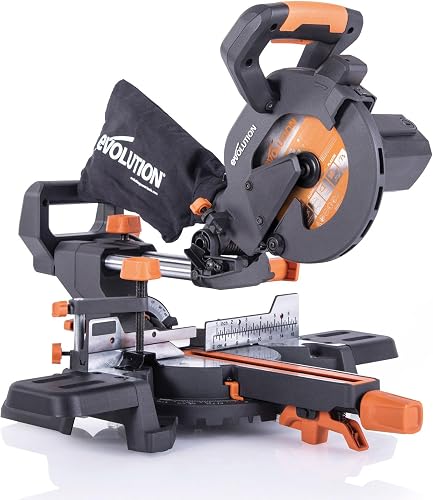
Best for: Users who need to cut various materials, including wood, plastic, and metal.
The multi-material capability is the standout feature here. The saw is designed to cut through mild steel without needing coolant, leaving an instantly workable finish. It uses a high-torque gearbox to manage the motor load, making it a rugged choice for demanding on-site jobs. The heavy-duty cast aluminum base provides a stable platform for these tougher tasks.
If your primary goal is furniture-grade cabinetry, look elsewhere. This tool prioritizes cross-material versatility over the micro-precision required for fine joinery. You can tell if this saw is right for you by looking at your material pile: if you frequently switch between square tube, angle iron, and wood, the R185SMS+ is built for your workflow.
Avoid this model if you only work with softwoods or hardwoods. You’ll be paying for a high-torque gearbox and metal-cutting capacity that will sit idle. If you don’t need to cut steel plate or pipe, the specialized features of this tool add unnecessary bulk to your workspace.
Good if:
- You need to cut metal, wood, and plastic with one tool.
- You want a dry-cutting saw that leaves a workable finish.
- You work on jobsites with mixed-material demands.
Skip it if:
- You’re exclusively focused on fine, high-end woodworking.
- You don’t have a need for metal-cutting capabilities.
8. WEN 15-Amp 10-Inch Dual-Bevel Sliding Compound Miter Saw with LED

Best for: Those prioritizing a cleaner workspace through improved dust collection.
This saw features a fan-assisted port that captures up to 90% of sawdust, which is a major benefit for indoor shops. It’s part of the Apex series, offering industrial-grade materials and a 12.2-inch crosscut capacity. The dual-bevel design and multiple positive stops give it the flexibility required for professional results.
If you struggle with airborne debris, rely on the fan-assisted system to maintain visibility. When working with wide stock, the smooth-glide system handles boards up to 3.5 inches thick. Use the 9 miter stops and 7 bevel stops to lock in common angles quickly.
It’s a larger, feature-heavy saw, so it isn’t for someone who needs a minimalist, “grab-and-go” tool. The focus is on performance and cleanliness in a dedicated shop setting. If you lack the space for a full-sized sliding unit, the footprint of this machine may prove cumbersome.
Good if:
- You want the cleanest possible work environment.
- You need a large 12.2-inch crosscut capacity.
- You want a tool with industrial-grade build quality.
Skip it if:
- You want a simple, lightweight saw for occasional use.
- You don’t have the space for a full-sized sliding saw.
9. DOVAMAN 12-Inch Dual-Bevel Sliding Compound Miter Saw

Best for: Users who need maximum horizontal cutting capacity for wide boards.
The 12-inch blade and sliding rail system allow for a cutting capacity of 4.2″ x 13″. This makes it ideal for large woodworking tasks where wide boards are standard. The inclusion of a laser guide helps with alignment, and the safety lock ensures that operation remains controlled.
Before your first cut, verify the miter angle. Although the factory calibrates the saw, shipping vibrations often cause slight misalignments. If your test cut shows a gap against a square, adjust the miter settings until the 0° preset aligns perfectly. Skipping this step leads to inaccurate joints that will ruin your finish work.
If you require a tool that works perfectly the second you unbox it, look elsewhere. This saw demands a brief calibration period to guarantee the precision its high-output motor is capable of delivering.
Good if:
- You need to cut very wide boards.
- You appreciate the visual aid of a laser guide.
- You want a high-capacity tool for large projects.
Skip it if:
- You aren’t comfortable checking or adjusting miter angles.
- You have very limited storage space.
10. Makita LS1040 10″ Compound Miter Saw

Best for: Users who want a compact, durable, and proven design for basic tasks.
This saw features a dual-post compound pivoting arm and a 15-amp direct drive motor for consistent performance at 4,600 RPM. It’s designed to be simple and sturdy, with a machined aluminum base that stands up to regular use. It handles common miter cuts from 0° to 45° left and 0° to 52° right, along with 45° left bevel cuts, without the added complexity of sliding rails.
Because this is a non-sliding model, its crosscut capacity is limited to the width of the blade’s reach. If you’re cutting boards wider than the blade diameter, you’ll hit a wall. Use this tool for standard trim and framing where precision matters more than board width.
You should choose this model if you prioritize a simple, reliable tool for a small shop footprint. However, skip it if your work requires the extended reach of a sliding compound saw. If you find yourself needing to cut materials wider than the blade path, you’re in the wrong category and should look for a sliding alternative to avoid incomplete cuts.
Choosing Miter Saws for DIYers and Contractors
Many of these saws share a high-output motor and a standard or large-diameter blade, which means they offer similar levels of raw power for standard wood cutting. The DEWALT DWS780, Metabo HPT C12RSH3, and DOVAMAN 12-Inch Sliding all occupy the “high-capacity” space, providing enough width for serious projects. If you’re comparing these, the decision often comes down to the specific locking mechanisms and the type of cutline indication (laser versus shadow) you prefer.
Conversely, the Makita LS1019L and Makita LS1040 are quite different from the sliding monsters. The LS1040 is a classic, compact compound saw, while the LS1019L uses clever engineering to give you sliding capacity in a tighter space. The Evolution R185SMS+ is in a league of its own for metal cutting, whereas the DEWALT DCS361B is the only real choice for a user who demands total cordless freedom. For those using power tools, it’s vital to follow the Occupational Safety and Health Administration guidelines for safe operation, as proper setup and use are essential regardless of which model you choose for your shop.
Still Not Sure?
How often will I really use it?
If you’re planning to use the saw daily for professional work, you need a model built for high-duty cycles, such as the DEWALT DWS780 or the Metabo HPT C12RSH3. These tools offer robust motors and extra features like shadow lines that save time over the long run. If you’re a weekend DIYer who only tackles a project once a month, you don’t need to pay for industrial-grade durability. A simpler, more compact model like the Metabo HPT C10FCG2 will handle your occasional needs without taking up too much space.
What do I already own that this has to work with?
Think about your current battery platform. If you have a collection of 20V MAX batteries from other power tools, the DEWALT DCS361B is the logical choice because you already have the power source. If you don’t have a battery ecosystem, you should stick with a corded model to ensure you have consistent power without needing to acquire new batteries and chargers.
What am I most likely to regret choosing?
The most common regret is buying a saw that’s too small for the boards you actually cut. If you frequently work with wide stock, don’t buy a non-sliding saw like the Makita LS1040, as you’ll quickly hit a wall in what you can achieve. Conversely, if you prioritize portability, you’ll regret buying a heavy, large-diameter saw that’s difficult to move. Be honest about whether you need the capacity of the DOVAMAN 12-Inch Sliding or the convenience of the Makita LS1019L, as these are very different tools for different habits.
Related guides
Frequently Asked Questions
Do I need a 10-inch or 12-inch miter saw?
A 10-inch saw is sufficient for most DIY trim and standard board widths, offering a lighter, more portable tool. A 12-inch saw provides greater cutting capacity for thicker or wider materials. You should choose based on whether your projects require the extra reach of a 12-inch blade or the portability of a 10-inch model.
Is a laser guide better than a shadow line?
Shadow lines are more accurate than laser guides because they are unaffected by blade width and remain visible in bright sunlight. They cast a clear mark exactly where the blade will cut. While lasers often require frequent calibration, shadow line systems provide consistent, quick alignment for various lighting conditions.
Why does my miter saw need a dual bevel?
A dual bevel saw allows the blade to tilt in both directions, which is essential for complex crown molding and intricate trim work. This flexibility eliminates the need to flip boards, reducing errors and saving time. Models like the Metabo HPT C12RSH3 or WEN Apex Pro offer this dual-direction capability.
How do I keep my miter saw accurate over time?
Accuracy depends on regular checks of the miter and bevel detent stops using a square. Most saws arrive factory-calibrated, but you should verify these angles before your first project. If the saw is not cutting square, most models include adjustment screws to reset the 0-degree stop for both angles.
Conclusion
Choosing a miter saw comes down to whether you prioritize the massive capacity of the DEWALT DWS780 or the space-saving, precision design of the Makita LS1019L. For large-scale projects where width is king, the DEWALT is a standard professional choice. If your work involves tight spaces and high-end finish carpentry, the Makita is likely your best companion.