Impact Driver Torque Explained: What the Numbers Actually Mean
Impact driver torque is measured in inch-pounds to show the turning force applied to a fastener, and this explains what those numbers actually mean. Compact models start around 1,000 inch-pounds while heavy-duty versions reach 2,000 inch-pounds or more. These figures help match a tool to your work, though they do not always tell the whole story.
What impact driver torque actually means
Torque is the twisting force an impact driver applies to a screw, bolt, or nut. Manufacturers list it in inch-pounds, which describes how much force one pound produces at the end of a one-inch lever. Higher numbers generally mean the tool can drive larger fasteners or loosen stuck ones. Speed isn’t torque; a fast driver may lack the force to set a long lag screw.
Choosing the right torque for your work
- Check the fastener size on your most common jobs. Small wood screws need far less force than structural bolts.
- Match the driver class to those fasteners: under 1,200 inch-pounds for light assembly, 1,500 to 1,800 for general construction, and above 2,000 for heavy framing or automotive work.
- Test the driver on a scrap piece of the same material before you start the real project.
- Start the fastener by hand so it seats straight, then apply the driver in short bursts.
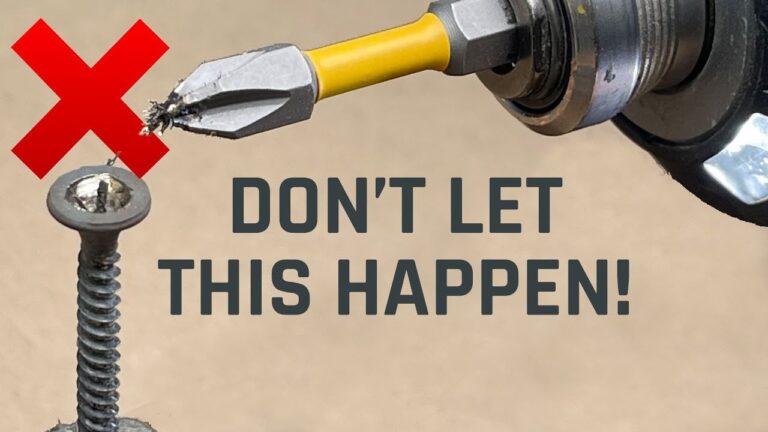
- Watch the head of the screw as it seats, and stop as soon as it’s flush to avoid stripping the drive.
- If the bit cam outs repeatedly, switch to a lower-torque setting or a different bit rather than pressing harder.
The single judgement call is knowing when to stop. If a job calls for precise torque, such as on engine components, use a calibrated torque wrench instead — impact drivers aren’t precision instruments.
Impact driver torque at a glance
| Situation | What to use | How long | What to watch for |
| Light assembly and furniture | Under 1,200 inch-pounds | All day | Stripping small screw heads |
| General construction and decking | 1,500 to 1,800 inch-pounds | All day | Battery drain on long days |
| Heavy framing and lag screws | 2,000 inch-pounds and up | All day | Tool weight and wrist fatigue |
| Automotive lug nuts and rusted bolts | 2,000 inch-pounds and up | Short bursts | Over-tightening fasteners |
| Precision or threaded assemblies | Torque wrench, not an impact driver | As needed | Under- or over-torquing |
What experienced users check before they start
Match the bit to the screw recess before pulling the trigger. A loose bit slips and rounds out the head. Check the battery charge, as a weak cell reduces torque. Pause during long runs to check if the driver is bogging down due to a dull bit or obstruction. Experienced users set the clutch or speed once rather than adjusting it for every screw.
Problems you might see and how to fix them
| What you notice | What it usually means | What to do first |
| Screw head strips or rounds out | Bit is the wrong size or worn | Switch to a fresh, correctly sized bit |
| Driver stalls on a large fastener | Torque is too low for the job | Move up to a higher-torque model |
| Fastener drives past flush | No torque control on the driver | Use a lower speed setting or a torque adapter |
| Battery dies quickly on big jobs | High-torque settings drain cells fast | Keep a second charged battery ready |
Rules and safety limits that matter
Eye protection is required whenever you drive fasteners, because bits can break and screws can snap under load. If a job calls for a certified torque value, such as on safety-critical bolts, a qualified mechanic or technician with a calibrated torque wrench should handle it.
Keeping your impact driver ready
Keep the tool clean and dry, and store it in its case or a dry shelf after use. Remove the battery before long-term storage, and check the chuck and bit holder for wear periodically. Never lubricate the internal hammer mechanism yourself unless the manual says to.
When an impact driver is the wrong tool
Don’t use an impact driver when a fastener needs a precise torque value; use a torque wrench instead. Avoid it for tiny screws in electronics or thin metal, where the sudden hammering action strips the recess before you can stop. It’s also the wrong choice for drilling holes; use a drill or drill driver instead.
Frequently asked questions
What does the torque number on an impact driver mean?
It’s the maximum twisting force the tool can apply, measured in inch-pounds, assuming a fully charged battery and a good bit.
How much torque do I need for deck screws?
About 1,500 to 1,800 inch-pounds handles most deck and framing screws in standard lumber.
Can I use an impact driver to remove lug nuts?
Yes, if the driver is rated at roughly 2,000 inch-pounds or more and the nuts aren’t seized or rusted solid.
Is more torque always better?
No. Extra torque makes the tool heavier and increases the risk of stripping small screws or snapping fasteners.
How long does an impact driver battery last on high torque?
A fully charged standard battery typically lasts several hours of intermittent driving, though continuous high-torque work drains it much faster.
What happens if I over-torque a screw?
The screw head strips, the threads strip, or the screw snaps, and the fastener usually has to be drilled out.
Do I need a torque wrench instead?
Yes, for any fastener where the manufacturer specifies an exact torque value, such as on engines or brakes.
Conclusion
Torque tells you what a tool can do, but it doesn’t tell you how well it will handle your actual fasteners. Match the number to the work, test on scrap, and stop before you strip the head.